
Curtain Tracks vs Rods: Which Is Right for Your Home?
A curtain track is a useful starting point for a discreet finish, matched S-fold curtains, wide openings and purpose-built motorisation. A curtain rod suits rooms where the pole, rings and finials are part of the design, and is the usual choice for eyelet curtains. Both can work with sheer or blockout fabric. The right choice depends on the heading, curtain weight, opening direction and available fixing points—not the fabric label alone. [1][2][3]
What is the difference between a curtain track and a rod?
A curtain track has carriers or gliders that travel inside a channel. Hooks or system-specific attachments connect the curtain to those carriers. Depending on the product, the track can be fixed to a wall, ceiling or purpose-built recess. [3][4]
A curtain rod, also called a curtain pole, usually carries rings that slide around its outside. Some curtain headings, including eyelets, thread directly onto the pole instead. The pole and its ends remain a visible part of the room. [1]
There is also a useful middle option: a decorative tracked pole. It looks like a rod but has an internal running channel. Some matched systems support wave headings, curved layouts or motorisation. A round profile does not automatically mean an ordinary rod-and-ring system. [5][6]
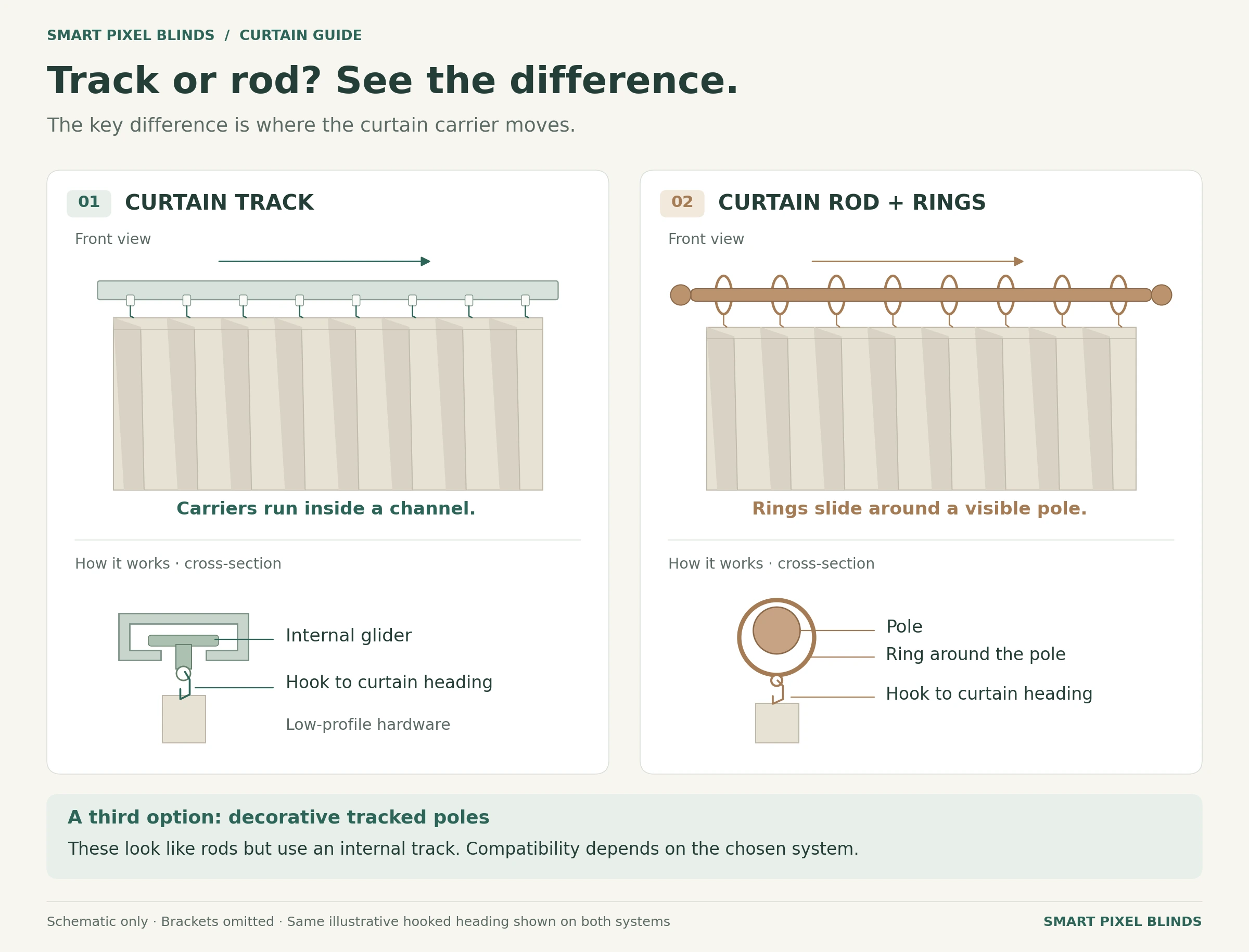
Curtain tracks vs rods at a glance
The rod column below refers to an ordinary rod using rings or a directly threaded curtain. Decorative tracked poles are a separate system.
Scroll across to compare all columns.
| What matters | Curtain track | Ordinary curtain rod |
|---|---|---|
| Visible finish | A discreet profile; concealment depends on the heading and installation | Pole, rings and finials can be a deliberate design feature |
| Sheer curtains | A practical starting point for a continuous S-fold sheer using matched carriers | Can suit compatible pleated, eyelet or other rod-based sheers |
| Blockout curtains | Suitable when the track, supports and fixings are rated for the complete curtain | Also possible with a suitably rated rod and compatible heading |
| Wide opening | A suitable continuous running channel can support flexible opening layouts | Intermediate supports may prevent ordinary rings from travelling across the full length |
| Two layers | Two independent channels can separate sheers and blockouts | A compatible double-rod arrangement can also separate two layers |
| Wall or ceiling fixing | Many systems offer either, with the correct brackets | Wall fixing is familiar; some ranges also provide ceiling brackets |
| Curves and bay windows | Selected systems can be bent to an approved radius | Requires a suitable bay, bent-pole or passing system |
| Motorisation | Select a purpose-built motorised system | Normally manual; any motorisation needs a separately verified solution |
| Noise and ease of use | Depend on the runners, joints, alignment and load | Depend on ring design, pole finish, joints, supports and load |
| Total cost | Depends on the specified system and installation | Depends on the specified system and installation |
Sources for the hardware distinctions: manufacturer product and compatibility information [2][3][4][5][6][7][8]. The selection advice is our synthesis of those distinctions; it is not a product performance test.
Start with your curtain heading
“Sheer” and “blockout” describe the fabric's light behaviour. They do not identify how the curtain attaches to its hardware.
Scroll across to compare all columns.
| Heading | Suitable track | Ordinary rod | What to check |
|---|---|---|---|
| S-fold / wave style | Use the matching carrier spacing, tape and hooks | Not a direct swap onto a plain pole with ordinary rings | A matched decorative tracked pole may be suitable; similar-looking systems are not automatically interchangeable |
| Double or triple pinch pleat | Usually possible with the correct hooks | Usually possible using compatible rings and hooks | Finished width, hook position and hanging height |
| Pencil pleat | Commonly used with hooks and gliders | Commonly used with hooks and rings | Gathering, attachment positions and finished drop |
| Inverted box pleat | Check the curtain's actual hook construction | Check the curtain's actual hook construction and ring arrangement | Confirm with the workroom instead of assuming from the heading name |
| Eyelet (existing-curtain comparison) | Not directly compatible | The pole passes through the eyelets | Pole diameter, eyelet clearance and any intermediate supports |
Turnils lists track and rod options for its wave, double pinch pleat and pencil pleat products. A manufacturer's “rod” option still requires the attachment arrangement specified for that particular system; it does not establish compatibility with an arbitrary pole and standard rings. Silent Gliss specifies coordinated tape and carrier arrangements for its Wave system. These examples support checking the complete system rather than treating every curtain with a similar-looking fold as interchangeable. [2][9]
Which option suits your room?
These are starting points for selection, not claims that one system is always better.
A living room with full-height S-fold sheers
Start by considering a matched track. Its discreet appearance lets the fabric become the main visual feature. A ceiling or high wall position can be assessed against the cornice, available fixings and intended finished drop. If you prefer a visible decorative pole, ask whether a compatible tracked-pole system can create the heading you want. [2][4][5]
A bedroom with both sheers and blockouts
Consider two independently operated layers. Double tracks are one way to achieve this; a suitable double-rod system is another. Confirm the room-to-glass order, the space required by both headings and how each layer will close. [7][18]
Sheer fabric alone should not be relied on for night-time privacy. Fabric opacity and the relationship between indoor and outdoor light need to be considered separately from the hardware. [11][17]
A wide sliding door that you use every day
Decide where the curtains will sit when open. A single stack to the left or right can suit a particular access route, but the hardware must allow the curtain to travel there.
Ordinary closed rings cannot pass an intermediate rod support. A continuous track, a compatible passing-ring system or a decorative tracked pole may offer a better layout for a one-side draw. Passing rings require their matching brackets. Do not remove a required support to create a travel path. [7][8]
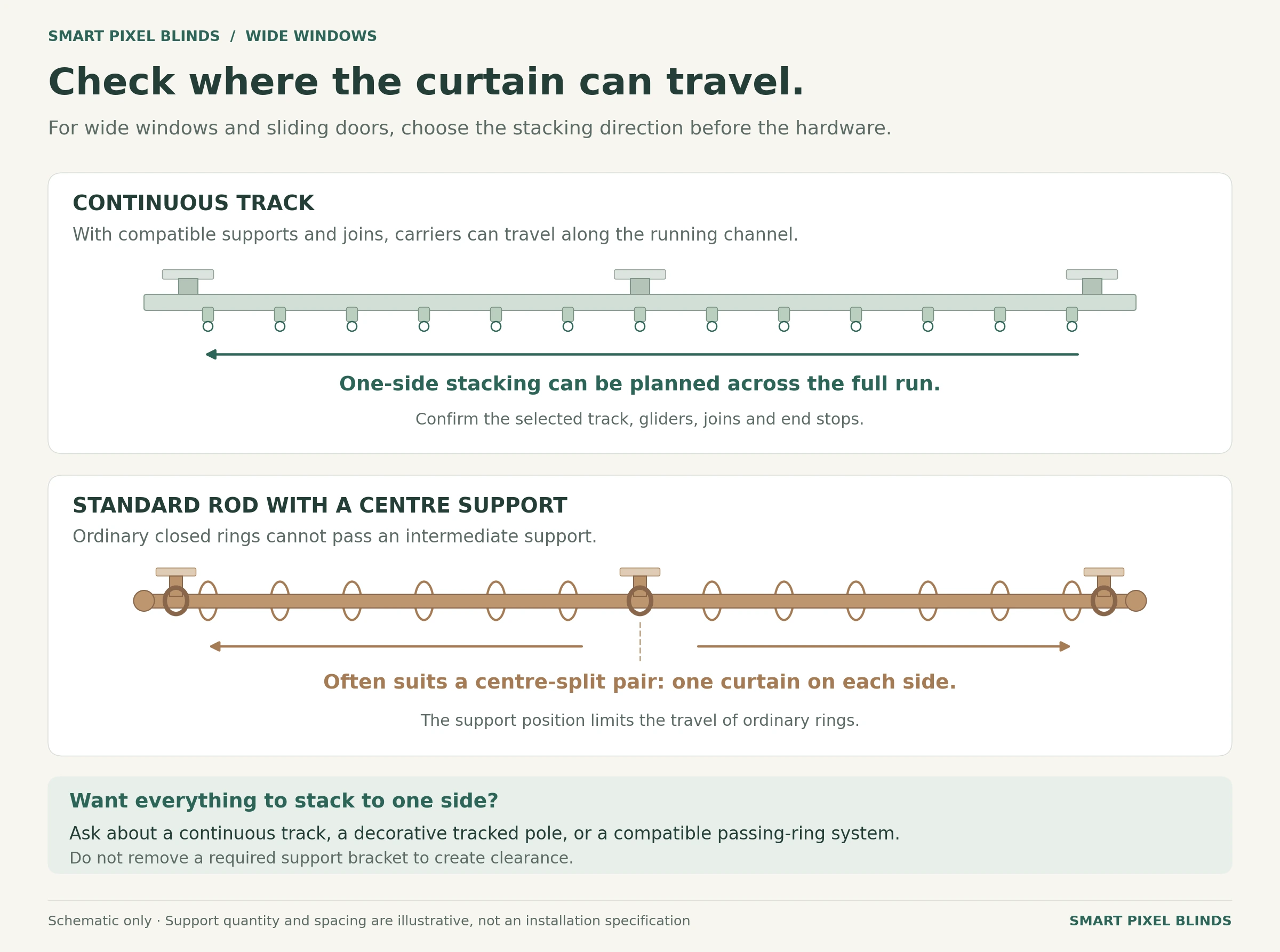
Plan curtain stacking and clearance
A room where you want the hardware on display
A rod can complement a room through its material, colour, rings and finials. This may suit a Queenslander renovation, a traditional room or a contemporary interior with carefully chosen metal finishes. That is a design preference, rather than a rule tied to the building's age. A simple rod can look contemporary; a track is not automatically the more premium option. [1][5]
A bay window or curved wall
Start with the actual shape and the intended movement of each curtain. Some tracks and decorative poles can be bent, while other rod systems use corner components and passing hardware. Confirm the approved bend radius and whether the curtain can move through the required corners. [3][5][8]
A high window, heavy curtain or planned smart-home setup
Choose the operating system early. Track and motor ratings need to suit the curtain load and layout, and the motor position and power arrangements need space. An ordinary manual track is not automatically ready for a future motor upgrade: for example, Forest identifies its KS as a manual system and points buyers to a different system for electric operation. [3][4]
An existing set of curtains you want to keep
Inspect the heading before ordering replacement hardware. A hooked pleat may be transferable after the hook arrangement and drop are checked. An eyelet curtain normally needs a pole, or an alteration to the heading. Changing from rings to track gliders can change where the curtain hangs even if the fixing height appears similar. [1][12]
Explore sheer curtains · Compare wall and ceiling fixing · Plan two independent curtain layers
Does a track provide better blockout?
A track can be part of a well-designed room-darkening arrangement, but the word “track” is not a blackout guarantee. A blockout fabric may still leave light paths around its edges.
Assess the top, sides and centre closing area together, as well as the chosen finished drop. Depending on the system, returns, overlaps and a pelmet or recess may help. Forest's specialist blackout solutions use different components for different light paths, illustrating why a complete specification matters. [10]
For a light-sensitive bedroom, discuss the desired room result during the measure. The same expectation should guide the fabric, heading and installation details.
Which is better for heavy curtains?
Neither category has one universal weight limit. A basic track should not be assumed to outperform a well-specified rod, and a substantial-looking rod should not be assumed to have unlimited capacity.
Check the complete curtain weight, the span, the supporting components and the fixing surface against the selected manufacturer's instructions. Lining and a long drop also form part of that assessment. Published limits belong to particular products and configurations; they are not general ratings for “tracks” or “rods”. [3][7][13]
Which costs less?
Ask for a like-for-like installed comparison. Compare the same curtain coverage, number of layers, heading, finish and opening direction. Include brackets, runners or rings, joins, decorative ends, any custom bends, installation and motorisation if required.
A shelf-priced straight rod and a fitted, custom double-track system are different scopes of work. The useful question is the total cost of the arrangement that does what your room needs. This guide deliberately does not attach a universal price range to either category.
Frequently asked questions
Can blockout curtains hang on a rod?
Yes, when the rod, brackets and fixings suit the load and the heading is compatible. Darkness still depends on the fabric and how the finished curtain covers the window. [1][10][13]
Can tracks be wall mounted, and rods be ceiling mounted?
Yes, suitable products exist for both arrangements. The correct brackets and a suitable fixing surface are required; the product name does not determine the mounting position. [3][7]
Can curtain rods be motorised?
Some decorative tracked-pole systems are motorised. Check the complete system before specifying a motor. Neither “all rods are manual” nor “any rod can be motorised” is a reliable buying rule. [6]
Can I keep my existing curtains if I change the hardware?
Sometimes. Check the heading, hooks, finished width and hanging point. Re-measure the finished drop for the new system before placing an order. [1][12]
Are curtain tracks always quieter?
There is no universal result based on the category name. Compare the specific runner or ring design, joint quality and installation. A properly matched and aligned system matters more than a blanket “track versus rod” claim. [3][13]
Are no-drill rods suitable for full-length curtains?
Check the exact product's rating and fixing method. Lightweight tension or net-curtain products should not be assumed to support full-length lined curtains. A room's existing fixings and permissions are also part of the practical choice. [1]
Which is easier to clean and maintain?
Ask how the specific system is maintained and how the curtain is removed for care. Follow the fabric care label and hardware supplier's instructions; a lubricant suitable for one product should not be assumed suitable for another. [19]
Choosing curtain hardware for your Brisbane home
Before choosing a track or rod, bring these decisions together:
- The fabric and heading you want.
- One layer or independently operated sheer and blockout layers.
- Left stack, right stack or centre split.
- Wall or ceiling fixing, with enough clearance around the window and room features.
- The desired light control and finished drop.
- Manual or motorised operation, now and in the future.
Smart Pixel Blinds offers free in-home measures across Brisbane, Moreton Bay, Logan and Ipswich. An in-home measure helps relate the curtain design to the actual window, available space and fixing position.
Article references
Primary manufacturer sources support product mechanics and compatibility. Retailer sources are used for their own buying and measurement guidance. A manufacturer's example demonstrates that a feature exists; it does not establish availability through Smart Pixel Blinds.
- [1]Dunelm — Tracks and poles buying guide. Attachment types, visual distinction and lightweight tension products.
- [2]Turnils — Curtain header styles. Wave, double pinch pleat and pencil pleat offered with track/rod options in its range.
- [3]Forest — KS Klick System. Model-specific mounting, bending, carriers and manual-only operation.
- [4]Silent Gliss Australia — SG 5100. A purpose-built electric track with wall, ceiling and recess options.
- [5]Silent Gliss Australia — Metropole. Decorative pole appearance with an internal gliding channel.
- [6]Forest — Rod systems. Distinct channel-rod, ring-rod and motorised rod offerings.
- [7]Jones Interiors — Brackets. Double, ceiling, support and passing-bracket arrangements; manufacturer-specific support rules.
- [8]Jones Interiors — Rings. Passing rings require compatible passing brackets.
- [9]Silent Gliss — Wave Curtain Workroom Guide. Matched tape, carrier and hook spacing. Numerical examples apply to the specified systems only.
- [10]Forest — Blackout curtain solutions. Separate treatment of centre, side and top light paths.
- [11]Luxaflex — Curtain collection. Sheer fabrics, daytime privacy and layering for different privacy requirements.
- [12]Veneta — Measuring windows for curtains. Heading, stacking and hanging-point differences; its numerical allowances must not be adopted as universal rules.
- [13]Forest — Manual curtain track systems. Different systems for different duty ranges. Comparison statements about a specific rod still require its own specification.
- [17]DIYblinds — S-Fold Curtains. Sheer and blockout S-fold options and night-time privacy considerations.
- [18]DIYblinds — Double-track installation guide. Independent front/rear tracks and wall/ceiling configurations; installation dimensions are product-specific.
- [19]Apollo — Curtains Care Instructions. Fabric care labels and supplier-specific hardware care; updated 14 September 2026.