
S-fold
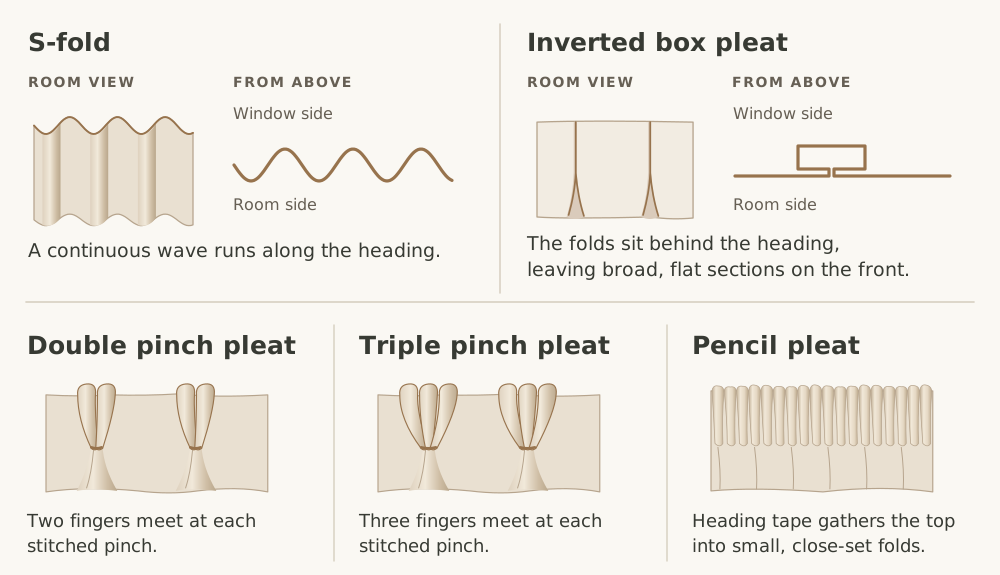
Also called S-wave, wave fold or ripple fold. The fabric travels alternately towards the room and the glass in a continuous curve. A compatible heading and spaced runners keep the wave even.
A curtain heading shapes the fabric at the top of the curtain. Smart Pixel Blinds offers all five styles below for sheers, curtains with a blockout coating and curtains with a separate blockout lining.
Also called S-wave, wave fold or ripple fold. The fabric travels alternately towards the room and the glass in a continuous curve. A compatible heading and spaced runners keep the wave even.
Also called inverted pleat or reverse pleat. The fabric folds back behind the heading, giving a flatter face from the room. Some suppliers shorten this to “box pleat”. Ask to see the front because the same name can describe a forward-facing box.
Two fingers rise from each stitched group, with flat fabric between groups. Also sold as two-finger, twin or Dutch pleat. It gives a tailored fold with less fullness at each pinch than the triple version.
Three fingers fan out from each stitched group. Also called three-finger pleat or French pleat. It gives a fuller heading and usually needs more room at the side than a double in the same fabric.
Drawcords in the heading tape gather the fabric into a continuous row of narrow folds. “Gathered heading” is a broader term. Check the tape or a close-up if you want this particular finish.
Compare the shape at the heading. For pinch pleats, count the fingers above a single stitched pinch.
Usually, yes. In Australian curtain catalogues, both names describe the regular wave you see from the room. The hook, tape and runner spacing can differ between brands. If you are ordering new fabric for an old track, check the hardware as well as the name.
Sometimes. Take one photo looking up into the track and another of a runner and hook from the side. S-fold systems generally use runners held at a set spacing. Many pinch-pleat curtains use individual gliders and hooks. The new heading, runners and track must work together and carry the fabric weight.
You can choose any of the five. An S-fold gives a sheer a continuous wave, while a double pinch gives it a more defined top. With a coated or separately lined blockout, try folding a sample to see how much space the fabric takes up when open. The fabric or lining provides the blockout, and the fit around the window affects edge light.
It can. The bundle of fabric left at the side is the stackback. A thick lining or a fuller triple pinch can make that bundle wider. Mark the edge of the door you walk through. We can compare a one-way draw towards the fixed glass with a centre-opening pair, and see whether there is wall space to extend the track.
Fullness compares the width of the flat fabric with the width it needs to cover once hung. For example, a 2× fullness specification means roughly two metres of flat fabric for one metre of finished coverage, before making allowances. When comparing quotes, check the heading, fullness and lining together.
They can be different. On a double track, each curtain has its own runners and moves independently. For example, pair an S-fold sheer with a pinch-pleated blockout if the tracks allow it. Check that the two layers pass each other freely, including when both curtains are stacked at the side.
Hold the same colour sample flat, then fold it loosely and tightly at your window. The shaded side of a fold can look darker. For sheers, put the sample against the glass in daylight. For a lined blockout, also look at it under the light you use at night.