
Should sheer or blockout curtains face the room?
Either layer can face the room on a double curtain track. Place the sheer in front to make its weave and folds the feature, or place the blockout in front to show its colour and texture. The final choice also depends on how you use each layer, the available space and the installation.
Choose the layer you see from the room
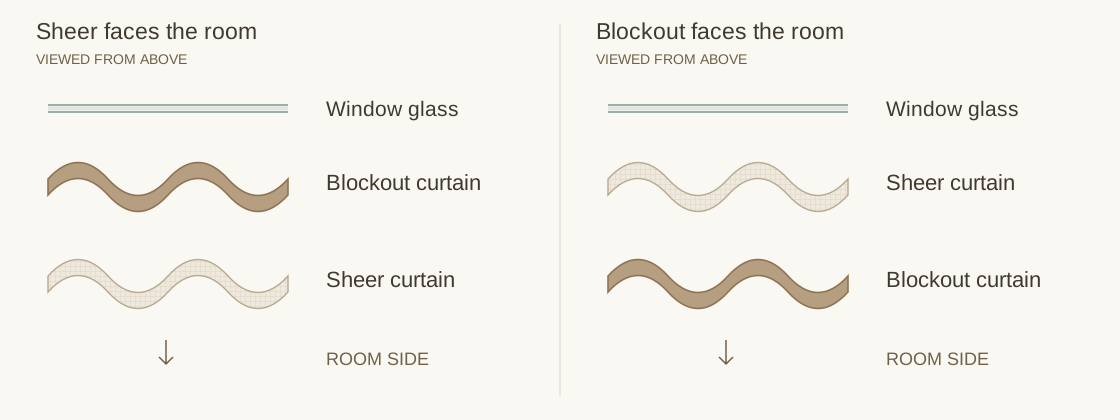
Both drawings show the glass at the top and the room below. Each layer runs on its own track. Track spacing is planned for the selected fabric and heading.
Consider support and the light around the edges
Heavier fabric and wall brackets
On a wall-fixed double-track system with shared projecting brackets, placing the heavier layer nearer the wall can reduce the leverage at the fixings. If the blockout is heavier than the sheer, this can favour a window-side blockout.
The tracks and fixings still need to support the full weight of both curtains. Bracket projection, fixing positions and the supporting wall all matter. Ceiling-fixed tracks are assessed separately for their support and fixing positions.
Light around the curtain
A window-side blockout may reduce angled side light if its position brings the fabric closer to the wall and allows it to cover the opening properly.
Room darkening also depends on side returns towards the wall, overlap where the curtains meet, top coverage and the gap above the floor. We check these details with your chosen heading and hardware when planning the layout.
How designers approach the choice
SAGE Interior Design & Decor
SAGE’s layering guide places the sheer towards the room so its fabric remains the feature. This approach gives the sheer’s texture a leading role in the interior. Read SAGE’s guide.
Shelley Ferguson Studio
In its Auckland White House living-room project, the studio used a breezy sheer in front of a blockout on double tracks. The project pairs this arrangement with generous glazing and a focus on natural light. View the project.
Nic Kaiko
Sydney designer Nic Kaiko describes a sheer close to the glass with a lined or blackout drape facing the room. His guide considers the relationship between the fabrics alongside the room’s light-control needs. Read Kaiko’s guide.
Using two curtain layers
Which layer should I close during the day and at night?
During the day, you can draw the sheer across and leave the blockout open for filtered daylight. Close the blockout when you want greater privacy or a darker room. Both arrangements let the layers operate independently, so you can also open both for a clearer view.
Can people see through the sheer at night?
When the room is brighter than outside, people may be able to see through the sheer. Close the blockout layer for night-time privacy. Daytime privacy also varies with the weave, lighting and viewing angle, so check the fabric against your own window.
Can both the sheer and blockout have an S-fold heading?
Yes, both layers can use S-fold headings when there is enough clearance for the folds and the selected tracking system. A combination of headings is also possible. We check the space each curtain needs when drawn across and stacked open before confirming the layout.
How will I reach the curtain on the back track?
Think about which layer you move most often. If the sheer usually stays drawn, a room-side blockout may be easier to reach by hand. With a back-track blockout, plan the control position and access around the sheer. We can check suitable controls with your selected track at the measure.
Does the blockout have to match the sheer?
You can choose closely related tones or a deliberate contrast. When the sheer faces the room, compare it with the blockout directly behind it as well as on its own. When the blockout faces the room, consider how it looks closed and how its open stack sits beside the sheer.
Can I swap the two layers after installation?
This depends on the track system, heading compatibility, curtain drops and available clearance. Check that both layers will hang and travel properly in the new positions, including when stacked open. Have the existing hardware and fixings assessed before changing the arrangement.