
How far should curtain tracks extend past a window?
Curtain overhang is the horizontal distance a track extends beyond each side of the window frame. It creates space for the curtains to gather when opened. The right amount depends on the fabric, heading, opening direction and the view you want to keep clear. Both sheer and blockout curtains need this planning. [1]
For a fully exposed window, the available space beside each end must accommodate the actual curtain stack on that side. Choose the fabric and heading, check their stack-back on the proposed track, then confirm the extensions against the room. [3]
Decide how much of the window you want to see
A curtain can frame a window with some fabric sitting over its edges when open. This creates a softer border and can work well where the side walls are narrow. Extending the track further allows more of the open curtain to sit beside the frame, revealing more glass. [2]
The decision is especially noticeable beside a sliding door or a favourite outlook. At a bedroom window, the proportions of the wall and furniture may matter just as much. Consider the everyday open position alongside the fully closed appearance.
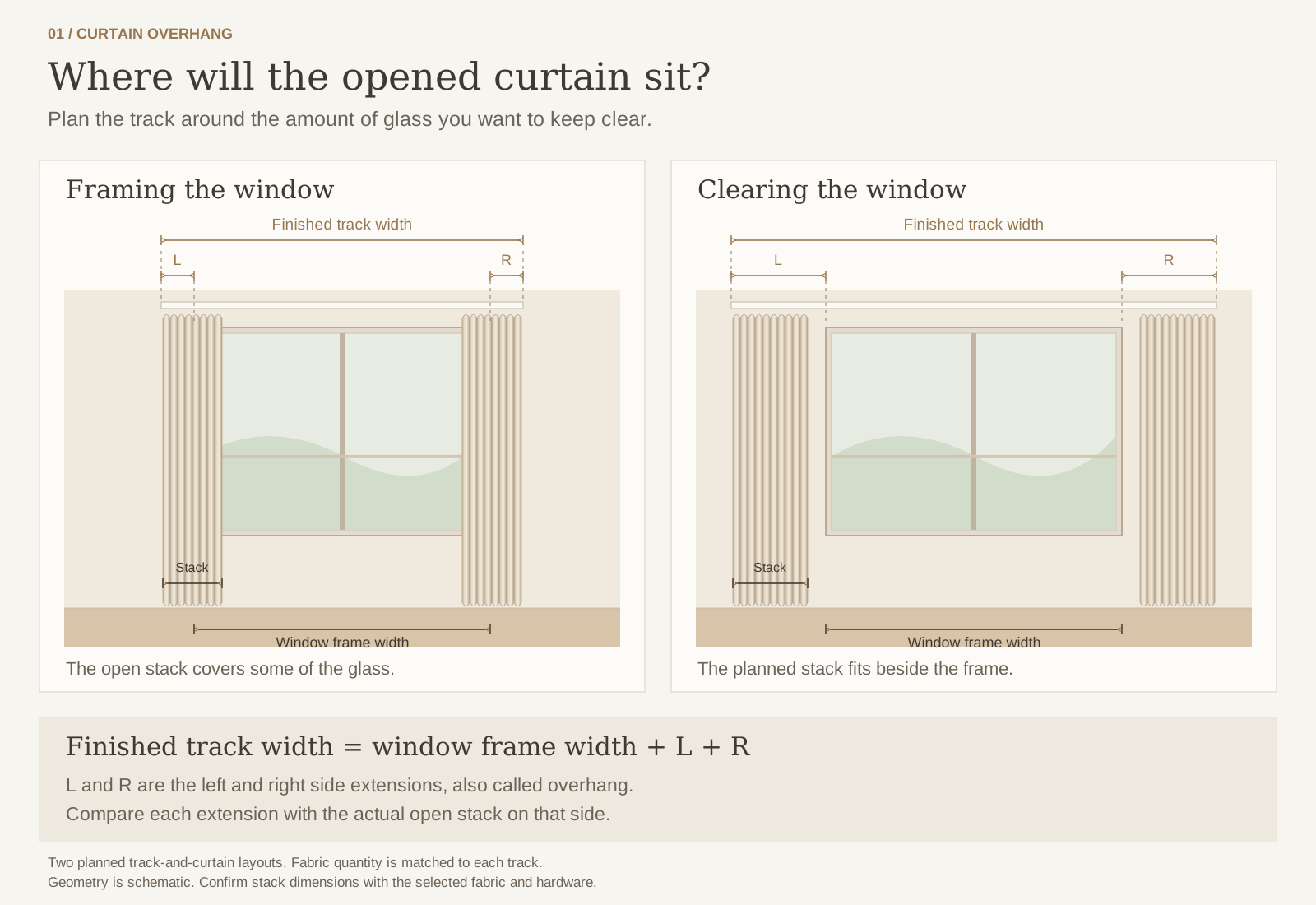
Can 150–200 mm on each side be enough?
It can suit a window-framing arrangement, depending on the curtain. A supplier's basic side allowance should be read together with its intended result. A measuring guide that allows 100–200 mm for framing a window can still leave some of the open curtain over the glass. [2]
If your priority is to clear the glass, work from the chosen curtain's stack-back. A wider curtain contains more fabric, and the heading configuration affects the stack. Kirsch's Ripplefold fabrication guide uses the selected fullness, carriers and opening arrangement when specifying a system. [3]
Ask for the proposed left extension, right extension and expected open stack on each side to be identified separately. That makes it easier to judge the result before the track is made.
Also check how the folds spread lower down the curtain. A neat heading can sit above a wider body of fabric. [11]
The measurements you will hear
| Term | What it means at your window |
|---|---|
| Overhang or track extension | The track length beyond the outside edge of the window frame on each side. |
| Stack-back, stackback or stacking width | The width occupied by the curtain when fully open. |
| Return | The curtain's outer edge turning back towards the wall. |
| Projection | The distance the track sits out from the wall. |
| Fullness | The extra fabric used to form the waves, pleats or gathers across the fitted width. |
| Centre overlap | The amount the leading edges cross when the curtains close, where the hardware and making method provide it. |
| Upstand | The part of the curtain heading above its hook or tape position. |
For a curtain rod or pole, the same side-extension principle applies. Use the working length between the finials when planning where the curtain can travel. [12]
These dimensions describe different parts of the finished curtain. Record the intended track width and leave the fabric calculation to the curtain maker. [1] [4]
How the five heading styles change the result
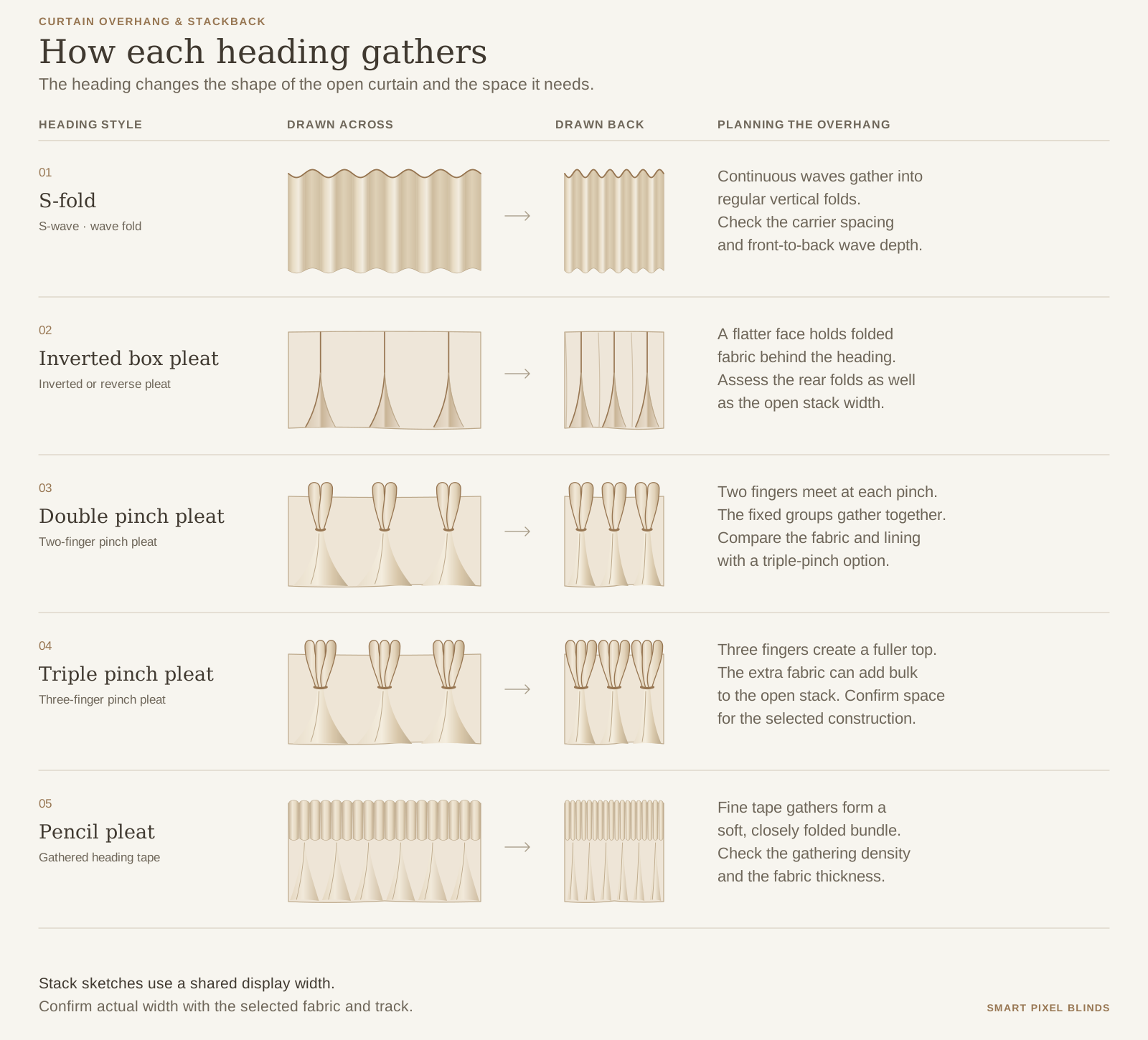
The heading shapes the curtain while it is closed and influences the way it gathers at the side. Compare the open stack as well as the front of the pleat. The fabric's thickness, flexibility, lining and fullness also affect the result. [5]
| Heading | Appearance and overhang considerations |
|---|---|
| S-fold | Also described as S-wave, wave fold or ripple fold. Repeating waves gather into a regular stack. Carrier spacing, compatible heading tape and the chosen fabric determine its shape. Allow room for the waves to extend forwards and backwards as well as along the track. [6] [11] |
| Inverted box pleat | Also called inverted pleat or reverse pleat. The front appears relatively flat, with fullness folded behind it. Check the actual open stack carefully. The flat front can disguise how much fabric is gathered at the side. [7] |
| Double pinch pleat | Two fingers form each sewn pleat. The fixed groups gather into ordered folds. It can be a useful option where side space is limited, particularly when compared with a fuller triple pinch construction in a similar fabric. [8] |
| Triple pinch pleat | Three fingers form each sewn pleat, giving a fuller heading. Compared with a similarly made double pinch curtain, the extra fabric can create a more substantial stack. Check its making specification and lining before settling the extension. [8] |
| Pencil pleat | Narrow gathers produce a softer, closely folded heading. The gathering density and fabric body affect how it collects when open. Its small pleats still need stacking space. Compare the finished curtain at the fullness intended for your window. [8] |
These names describe a family of appearances. Track components, carrier spacing and making specifications should be checked with the selected supplier, particularly for wave systems. Compare the pleat details in our heading guide. Curtain heading styles
Choose Centre Split, Left or Right
With Centre Split, the curtain opens from the middle and gathers at both ends. Each side needs space for its own stack. A Left opening gathers the curtain on the left when viewed from inside the room. A Right opening gathers it on the right. A one-way curtain concentrates its fabric on one side. [4]
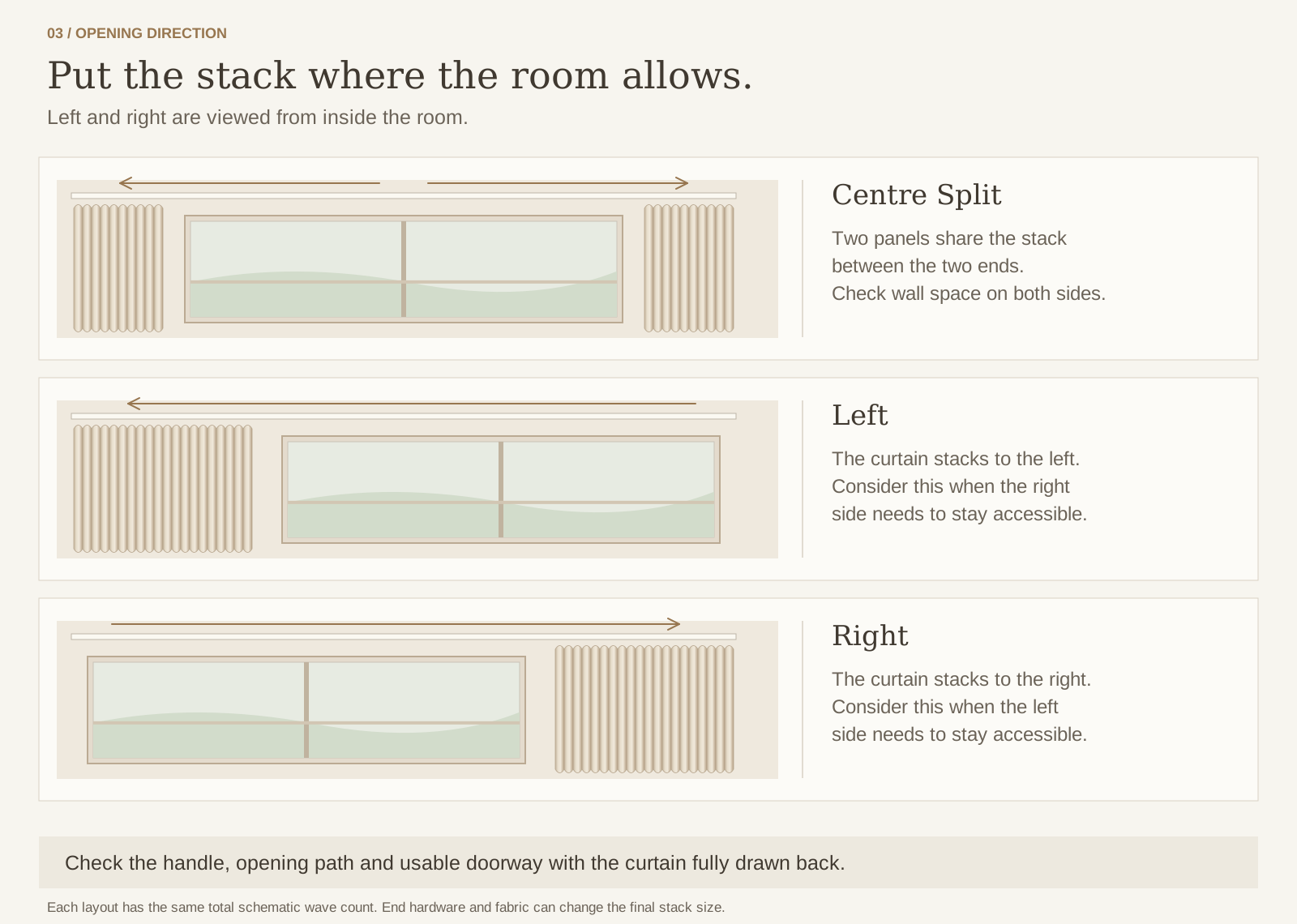
Walk through the doorway and operate its handle before deciding where the stack belongs. Check the path of inward-opening doors, nearby furniture and access to switches. For an off-centre window, different left and right extensions can make better use of the available wall. [4]
Sheers, blockouts and double tracks
Sheers look light, yet a full-width sheer still gathers into layers when opened. Its stack depends on the fabric and heading. A lined blockout can produce a bulkier stack, while different coated fabrics have different thickness and stiffness. Judge the complete curtain specification. [2]
On a double track, check each layer's stack-back and the depth between the tracks. The sheer and blockout may occupy some of the same side-wall area while sitting on separate front-to-back paths. Both need space to move freely, including around handles, sills and the other curtain's folds. [9]
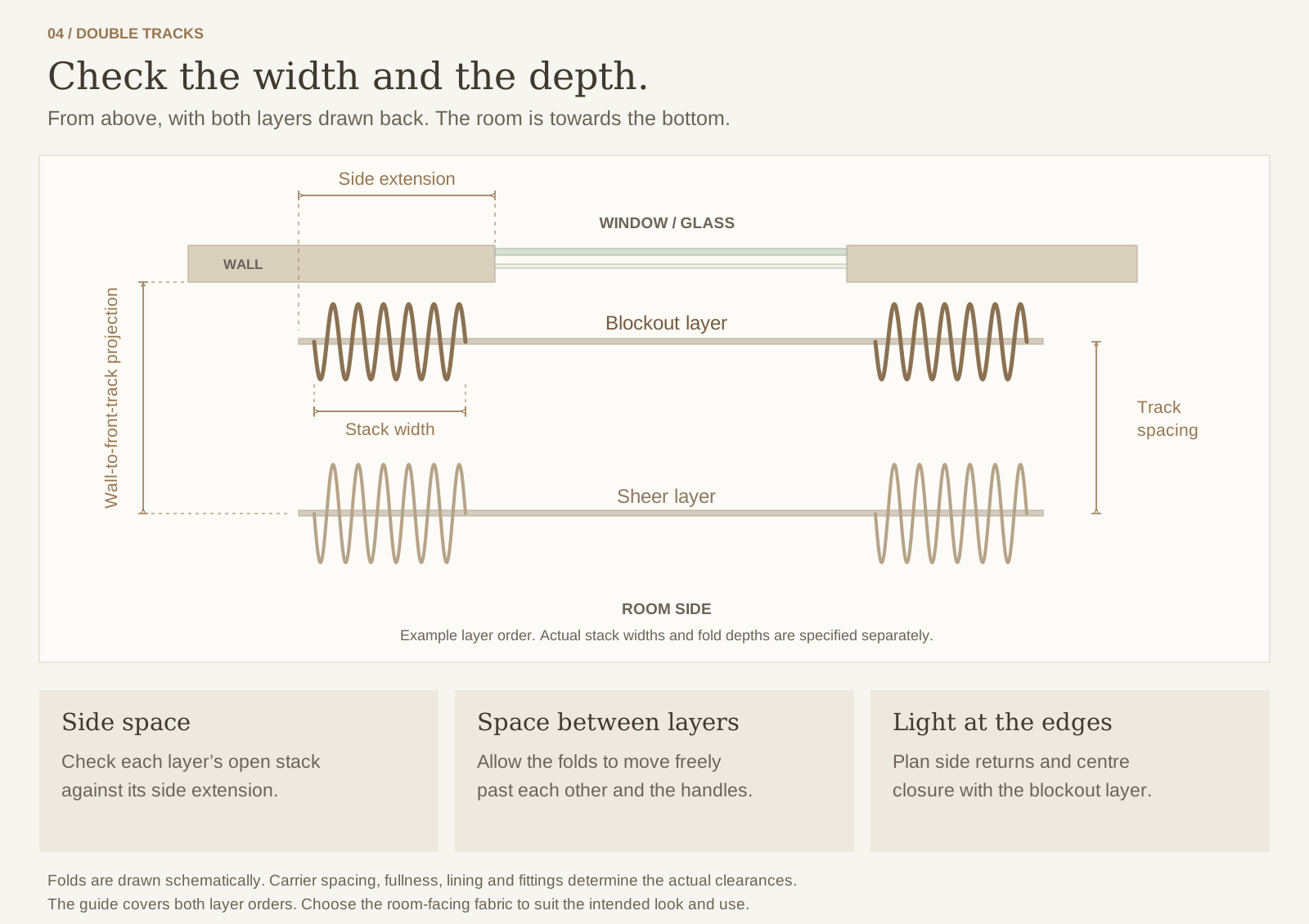
The room-facing layer also changes what you see when both curtains are closed. Sheer and blockout layer order
A simple track-width example
For a straight track, add the chosen extensions to the outside window-frame width.
Track width = window-frame width + left extension + right extension
| Example measurement | Width |
|---|---|
| Outside window-frame width | 2,400 mm |
| Selected left extension | 350 mm |
| Selected right extension | 450 mm |
| Resulting track width | 3,200 mm |
The extensions in this example are selected dimensions for showing the calculation. The actual curtain stacks must be checked separately against those spaces. Increasing the track width also changes the width the curtains must cover, so confirm the curtain making and stack-back together.
Questions to ask before the final measure
Should I measure the glass or the window frame?
Use the outside edges of the frame as the reference for side extensions. Also record the planned track width. These two measurements show both the window being covered and the full distance the curtains will travel. [4]
Does ceiling mounting change the required overhang?
The horizontal planning still depends on the open stack and the view you want. Ceiling and wall mounting affect the fixing position and projection. Check those alongside the curtain's side space. Curtain track mounting guide
Can an existing track simply be made longer?
Check the existing curtain's finished width first. Fixed pleated headings are made to cover a particular width. A longer track can require alterations or new curtains, and the track system must also support the proposed extension. [10]
Should the track run wall to wall?
A wall-to-wall treatment can create a continuous fabric backdrop and accommodate off-centre windows. Check the available ends and the finished stacks against the glass you want exposed. The room's full width becomes part of the curtain-making plan. [2]
Is a stack-back percentage for each side or the whole track?
The quotation should identify whether the figure describes one panel or the combined stack, and whether it uses window width or finished track width. Adding a percentage to window width and calculating a stack as a percentage of track width produce different measurements. Ask for each side's final allowance in millimetres.
Do two curtain layers need twice the side allowance?
Assess both stacks in their separate track positions. Their front-to-back arrangement allows side-wall areas to overlap, while each layer still needs sufficient travel and clearance. The final dimensions depend on both fabrics, their headings and the track arrangement. [9]
Will extra overhang improve blockout performance?
Extending the coverage beyond the frame can help with edge light. The side return, centre closure, track position and other perimeter gaps also matter. Plan the complete coverage around the window when discussing a darker bedroom. [1] [9]
What if the window is close to a corner?
Record the clear wall space at both ends and the depth of any adjoining treatment. A one-way opening may use the more generous side. Where curtains meet around a corner, review the track shape, return and the movement of both curtains together.