Inside or outside mount for blinds and shutters
A reveal fit sits within the window opening. A face fit sits in front of it, inside the room. Look at the trim you want to see, how far the fittings project and whether there is space to cover the edges of the opening.
Two ways to fit the opening
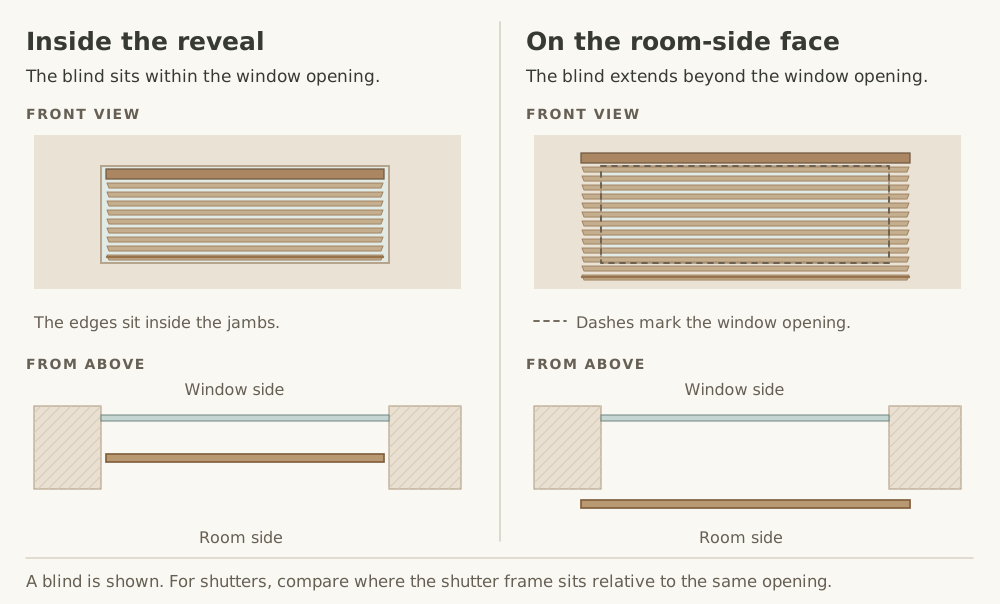
A timber Venetian illustrates the two positions. For plantation shutters, picture the surrounding shutter frame in the same two positions.
Inside mount
Also called reveal fit, recess fit, recess mount or inside fit. The reveal is the inner lining of the opening. This position can leave decorative trim visible. Check the working depth up to the nearest handle, lock or flyscreen.
Outside mount
Also called face fit, face mount or outside fit. The blind or shutter frame sits on the room-side wall or on suitable architrave, the trim around the opening. It can overlap the edges. An adjoining wall, projecting sill or cabinet can limit that overlap.
Choosing the right fit
Will an inside mount sit flush with the trim?
Only if the product fits within the available clear depth. A bracket can fit inside while the roller, Venetian headrail or shutter frame still projects. If a flush finish matters, ask to see where the front edge will sit when you look at it from the side.
What if my window is shallow or out of square?
The usable depth and the narrowest part of the opening may limit a reveal fit. A face fit is worth comparing if suitable fixing points and room for overlap are available. At the measure, show us any part of the trim or sill you want left visible.
Can an inside blind also be top-fixed?
Yes. A suitable bracket can fix upwards into the top of the recess. The blind is still inside the opening.
What needs to clear the window
Will a blockout roller blind stop light around the sides?
Blockout fabric stops light passing through the cloth. The roller fabric is narrower than the bracket-to-bracket width, so a reveal fit can leave strips of daylight. A face fit with enough side overlap can reduce them. The distance from the wall and the space above the roll also matter. In a bedroom, show us where early sun reaches the pillow.
Will timber Venetian slats catch my window winder?
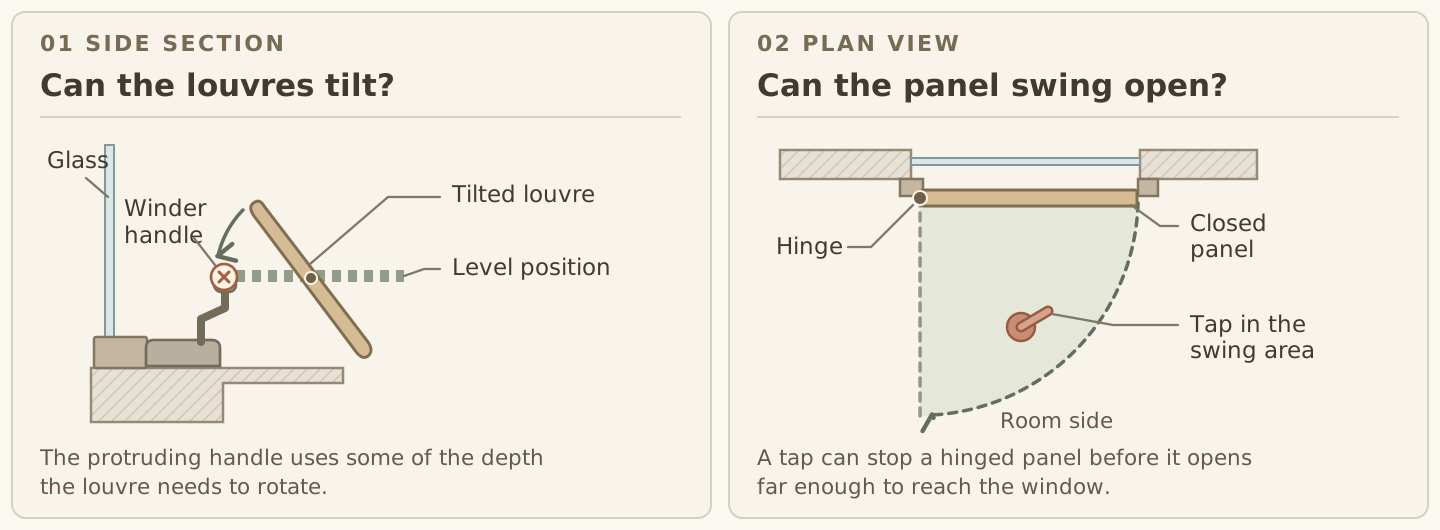
They can if the slats and winder occupy the same space. Check the depth of the top rail, the sweep of a tilting slat and the space your hand needs. When raised, the slats stack beneath the headrail and may cover the top of the glass. A higher face fit can leave more glass clear if there is wall space above the opening.
Can I open a hinged plantation shutter past a tap or desk?
Try the two movements separately. Tilting the louvres needs clearance behind the panel, particularly at handles or winders. Opening the whole panel needs a clear arc into the room. A face-mounted frame can move the louvres further from the glass, but a tap or desk can still block the swing.
Two clearance checks for hinged shutters
Enlarge diagram